- NextCareerStep
- Posts
- Google Wants to Power AI From Space
Google Wants to Power AI From Space
Simplest Way To Create and Launch AI Agents (Get $20 Worth of FREE Credit)

Shailesh Shakya
November 11, 2025

Google has unveiled Project Suncatcher to Power AI From Space
Simplest Way To Create and Launch AI Agents (Get $20 Worth of FREE Credit)
Building AI Agents and Agentic Workflows Specialization
How to become irreplaceable by AI (By Jeff Bezos)
Job & Career Updates 2025
Google has unveiled Project Suncatcher to Power AI From Space (Source)

Google has unveiled Project Suncatcher, an ambitious research initiative to scale machine learning computation in space. The project envisions a network of solar-powered satellites equipped with Tensor Processing Units (TPUs) to harness the Sun’s energy for large-scale AI workloads.
Drawing inspiration from previous Google moonshots such as self-driving cars and quantum computing, Suncatcher aims to explore how orbital computing infrastructure could unlock new frontiers in AI scalability and sustainability. The company’s initial research, detailed in a preprint paper, outlines the design, control, and communication architecture for the satellite constellation, along with radiation testing results for TPUs operating in space conditions.
The next phase will involve a joint mission with Planet, launching two prototype satellites by early 2027. These will test Google’s AI hardware in orbit, serving as the foundation for a potential future of solar-powered, space-based computation… a step toward an era where AI literally draws its power from the stars.
Simplest Way To Create and Launch AI Agents (Get $20 Worth of FREE Credit)
The Simplest Way To Create and Launch AI Agents
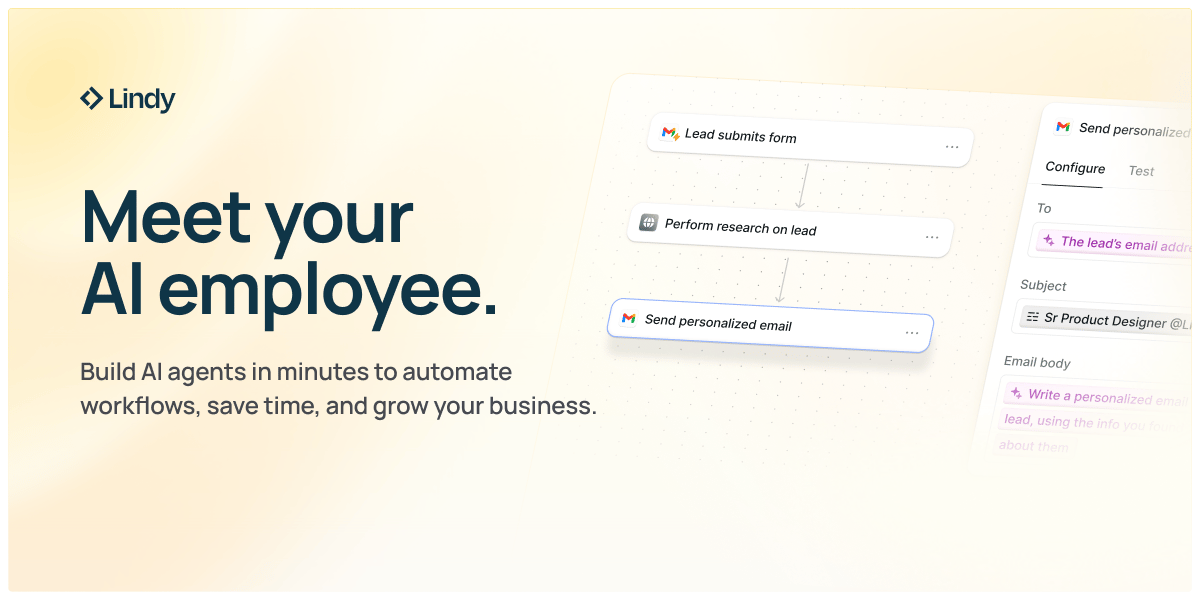
Imagine if ChatGPT, Zapier, and Webflow all had a baby. That's Lindy.
With Lindy, you can build AI agents and apps in minutes simply by describing what you want in plain English.
From inbound lead qualification to AI-powered customer support and full-blown apps, Lindy has hundreds of agents that are ready to work for you 24/7/365.
Stop doing repetitive tasks manually. Let Lindy automate workflows, save time, and grow your business.
Building AI Agents and Agentic Workflows Specialization
Develop agentic AI applications that integrate tools, support reasoning, and improve performance through reflection
Design AI agents with LangGraph using agentic AI design principles such as memory, iteration, RAG, and workflow patterns
Orchestrate agentic multi-agent systems with CrewAI for collaboration, coordination, and workflows
Build conversation-driven agentic AI assistants with BeeAI and AG2; compare AI frameworks for real-world use case applicability
How to become irreplaceable by AI (By Jeff Bezos)
The Core Principle: Innovation Over Credentials
Jeff Bezos focuses on one critical interview question: "Give me an example of something you've invented."
This isn't about patents or groundbreaking products. It could be:
A new metric you created
A business process you designed
A unique solution to a recurring problem
In the AI era, thousands of candidates use ChatGPT to polish resumes and craft perfect answers. But AI can't replicate genuine innovation because:
AI optimizes existing solutions - it doesn't create truly novel approaches
Innovation requires experimentation - venturing into uncertainty where outcomes aren't guaranteed
Creative problem-solving is uniquely human - finding ways to do "both A and B" instead of choosing between them
Bezos' Selection Philosophy
He looks for people who:
Invent their way out of problems rather than accepting false choices
Embrace uncertainty and exploration, even when paths lead to dead ends
View failure as learning - "failure and invention are inseparable twins"
As Bezos notes: "If you know in advance that it's going to work, it's not an experiment."
Innovation drives approximately 50% of annual GDP growth. Leaders like Musk, Zuckerberg, and Gates didn't just build businesses—they transformed entire industries by innovating, not imitating.
To be irreplaceable by AI: Don't just execute tasks efficiently. Instead, demonstrate your ability to:
Create novel solutions to problems
Experiment and learn from failures
Think beyond either/or choices to find innovative "both/and" solutions
AI can optimize, automate, and assist…but it can't pioneer into genuine uncertainty and create something that's never existed before. That's your competitive advantage.
Job & Career Updates 2025
153,000 Workers Axed in October Alone: AI Takes the Blame (Source)
October 2025 saw a shocking 153,074 job cuts announced across the U.S. The highest October total since 2003 and up 175% from last year. Year-to-date layoffs have surpassed 1.1 million, matching levels not seen since the 2008 financial crisis.
The technology sector led the bloodbath with 33,281 cuts in October alone, bringing tech layoffs to 141,159 for the year. What's driving this? Companies cite cost-cutting and AI adoption as the primary reasons, with AI responsible for 48,414 job cuts this year.
The warehousing sector also got hammered with 47,878 cuts in October, suggesting automation is hitting physical labor too. Most concerning: companies are breaking their long-standing tradition of avoiding fourth-quarter layoffs, signaling genuine economic stress rather than just restructuring.
Why Middle-Class Jobs Are Vanishing While Top and Bottom Thrive
AI isn't just eliminating jobs…it's creating a bizarre polarization in the job market that researchers call the "dumbbell effect." Both high-skill and low-skill jobs are growing while mid-skill positions are vanishing. In China's AI sector, job postings grew 11% year-over-year in Q3 2025, but job seekers surged 23%, creating fierce competition. Research shows generative AI hits junior positions hardest…not through mass layoffs, but by freezing new hiring while promoting existing employees faster.
Graduates from mid-tier universities are getting squeezed the most, while top-tier and lower-tier institution grads fare better.
The takeaway? If you're in a mid-skill role involving repetitive, standardized work (think administrative clerks or paralegals), you're in the danger zone. But there's hope at both ends: algorithm engineers and AI product managers are in hot demand, while low-skill data annotation jobs provide transition paths for displaced workers.
U.S. Jobs Market Crosses the Recession Threshold
The U.S. labor market is sending some seriously concerning signals. Job growth has collapsed to just 0.5% year-over-year in October 2025, down from 1.7% at the start of the year. Average monthly job additions over three months have plummeted to a meager 29,300. Long-term unemployment (27+ weeks) has surged from 21.5% to 25.7% of total unemployed…historically, crossing that 25% threshold has signaled or preceded recessions. The unemployment rate climbed from 4.0% to 4.3%, with forecasts suggesting 4.5% by year-end.
Making matters worse, a 37-day federal government shutdown delayed official jobs data, forcing markets to fly blind. The Federal Reserve is caught in a bind: cut rates to support jobs or hold firm against 3% inflation? Consumer discretionary sectors like airlines, retail, and luxury goods are getting hammered as households tighten belts, while defensive sectors like healthcare, utilities, and consumer staples remain relatively stable.
Meta's $600B AI Infrastructure Bet
While laying off workers, Meta is making history with an absolutely massive $600 billion commitment through 2028 to build AI-optimized data centers across America. This investment has already created over 30,000 skilled trade jobs and 5,000 operational positions since 2010.
Meta is positioning itself as one of the largest customers of U.S. contractors and manufacturers, keeping economic benefits flowing to American businesses. The company is working directly with utilities to add 15 gigawatts of new energy capacity…enough to power 11 million homes…and plans to be water positive by 2030.
Through community grants, Meta has distributed $58 million to schools, nonprofits, and community projects. This isn't just corporate expansion; it's a strategic move to cement America's AI dominance while other tech giants like Microsoft, Amazon, and Alphabet collectively spend roughly $375 billion this year on AI infrastructure. The message is clear: AI infrastructure is the new oil rush, and companies are betting trillions on it.
100,000+ Jobs Slashed as Giants Choose Machines Over People
Major tech companies have collectively slashed over 100,000 jobs in 2025, with Intel leading at 33,900 cuts (22-31% of its workforce depending on the source), followed by Amazon (19,555), and Microsoft (19,215). Other heavy hitters include TCS (12,000), Meta (4,320-8,000), and IBM (9,000). These aren't just pandemic-era correction cuts anymore—they're strategic realignments focused on AI efficiency.
Amazon's SVP cited AI-driven business changes as the direct reason for 14,000 eliminated positions. Companies are using euphemisms like "reorganization" and "optimization" in layoff announcements, leading to accusations of "AI-washing"…using AI hype to justify broader cost reductions. The human toll is devastating: only 5.3% of laid-off tech workers get rehired according to recent studies, though that number is slowly rising.
Entry-level tech jobs are down 20% since 2022, and 627 tech workers lost their jobs daily in the first half of 2025. Yet experts argue this isn't pure AI displacement…it's restructuring, with companies shedding roles automation can handle while redirecting resources toward AI development and cloud expansion.
The $3 Trillion Gamble: Tech Giants Bet Everything on AI
Despite bubble concerns, AI infrastructure spending continues its meteoric rise with no end in sight. Nvidia became the first company to surpass $5 trillion in market value, while Microsoft, Amazon, Meta, and Alphabet are expected to spend roughly $350 billion combined this year and Goldman Sachs estimates global AI-related infrastructure spending could hit $3-4 trillion by 2030.
The AI supply chain now spans power generation, industrials, cooling technology, semiconductors, and cloud infrastructure. Over 100 non-tech companies mentioned data centers on quarterly calls, including Honeywell and Caterpillar (whose data center division sales jumped 31%). The catch? Sales-to-capex ratios at major tech firms have fallen sharply as spending grows faster than revenue, raising concerns about when returns will materialize.
Oracle issued an $18 billion bond sale, and Meta planned up to $30 billion…some of the largest tech debt offerings ever. The useful life of AI chips is shrinking to five years or less, forcing companies to write down assets faster and replace them sooner. Still, economists point out that AI investment is currently less than 1% of U.S. GDP, far below the 2-5% peaks seen during electricity and dot-com booms, suggesting we're in the "early innings" of this transformation.
Why AI Is Hunting White-Collar Workers First
AI is hitting white-collar jobs first and hardest. Entry-level programming jobs have become nearly impossible to secure as AI excels at coding, and knowledge worker positions on Wall Street and at law firms are shrinking because AI can look up information and summarize it faster than humans.
The least exposed jobs? Blue-collar roles requiring physical dexterity and muscle—we don't yet have robotics capable of matching human capabilities in those areas. The hyperscalers (AWS, Microsoft Azure, Google Cloud) are clear beneficiaries as they provide the compute capacity AI demands, benefiting chipmakers and the power sector in turn.
But here's the anxiety-inducing part: experts warn about unemployment concerns across sectors and countries with potential geopolitical implications, plus safety concerns about AI making decisions without humans in the loop. Once we reach artificial general intelligence (AGI), where machines match human intelligence, and then superintelligence, things could become unpredictable. Right now there's a global race with China to develop AI fastest, often with guardrails as a secondary concern.
78 Million New Jobs Coming by 2030: But 120 Million Workers Won't Be Ready
Here's the good news: the World Economic Forum's Future of Jobs Report 2025 projects 170 million new roles will be created by 2030 while 92 million are displaced—a net gain of 78 million jobs. The bad news? Job disruption will equal 22% of all jobs, and nearly 40% of skills required will change. The skills gap is the biggest barrier to business transformation, cited by 63% of employers.
If the global workforce were 100 people, 59 would need reskilling by 2030…and 11 of them are unlikely to receive it, translating to over 120 million workers at risk of redundancy. The jobs seeing highest growth? Frontline roles (farmworkers, delivery drivers, construction), care jobs (nursing professionals), and education roles (teachers) due to demographic trends.
Technology skills in AI, big data, networks, and cybersecurity will see fastest demand growth, but human skills like analytical thinking, resilience, leadership, and collaboration remain critical. Half of employers plan to reorient their business for AI opportunities, with 77% planning to upskill workers but 41% planning workforce reductions as AI automates tasks. The rising cost of living is expected to displace 6 million jobs globally by 2030, while demographic shifts and geopolitical tensions add more pressure.
Custom GPT That Writes Resumes Under 5 Minutes
Crafting a résumé shouldn’t feel like a full-time job. Yet most job seekers spend hours tweaking bullet points, reformatting sections, and rewriting summaries only to get rejected without explanation.
Even worse? Many turn to ChatGPT hoping it will “just write a résumé,” but the results are usually generic, robotic, and instantly ignored by recruiters.
You end up wasting even more time prompting, editing, and re-prompting and still don’t get interviews.
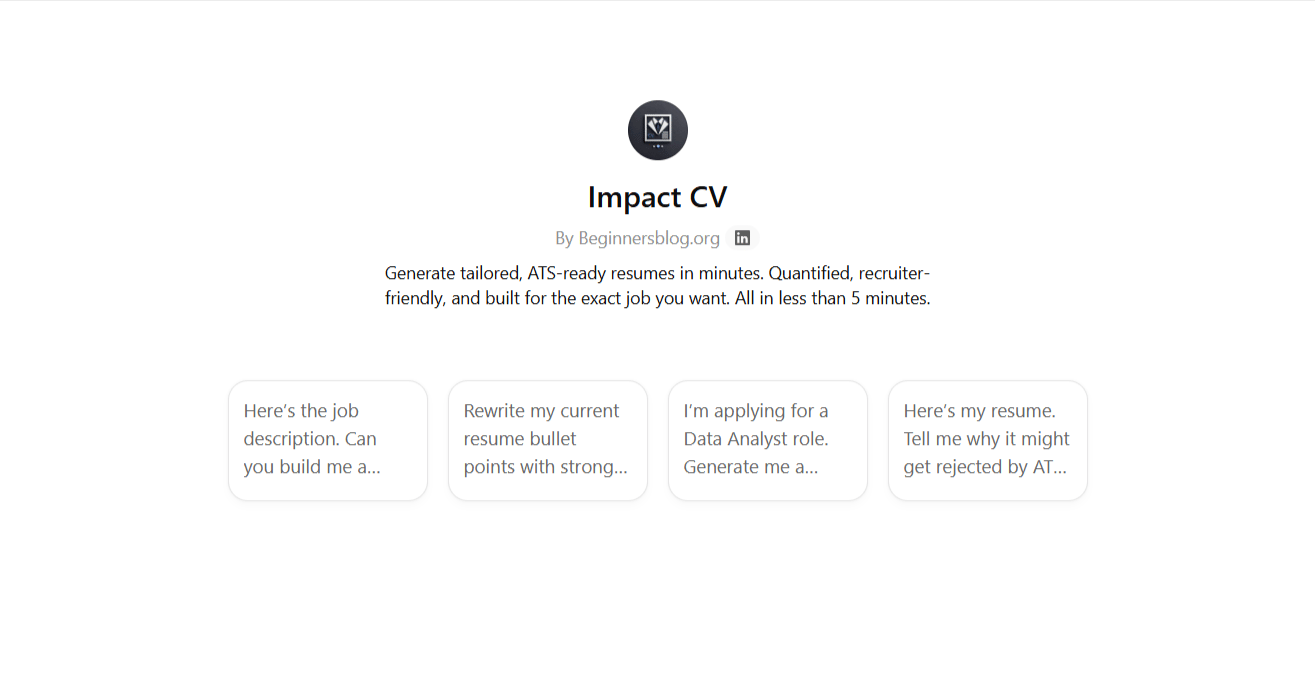
That’s why I built Impact CV GPT. A ChatGPT tool trained specifically on REUSME to help you Generate tailored, ATS-ready resumes in minutes. Quantified, recruiter-friendly, and built for the exact job you want. All in less than 5 minutes.
How much are satisfied with today's newsletter |
Until next time - shailesh and NextStepCareer